

Nov-2025 Fortinet NSE8_812 Actual Questions and Braindumps
NSE8_812 Dumps To Pass Fortinet Exam in 24 Hours - Prep4away
NEW QUESTION # 11
What is the benefit of using FortiGate NAC LAN Segments?
- A. It allows for assignment of dynamic address objects matching NAC policy.
- B. It provides support for multiple DHCP servers within the same VLAN.
- C. It provides physical isolation without changing the IP address of hosts.
- D. It provides support for IGMP snooping between hosts within the same VLAN
Answer: A
Explanation:
FortiGate NAC LAN Segments are a feature that allows users to assign different VLANs to different LAN segments without changing the IP address of hosts or bouncing the switch port. This provides physical isolation while maintaining firewall sessions and avoiding DHCP issues. One benefit of using FortiGate NAC LAN Segments is that it allows for assignment of dynamic address objects matching NAC policy. This means that users can create firewall policies based on dynamic address objects that match the NAC policy criteria, such as device type, OS type, MAC address, etc. This simplifies firewall policy management and enhances security by applying different security profiles to different types of devices. Reference: https://docs.fortinet.com/document/fortigate/7.0.0/new-features/856212/nac-lan-segments-7-0-1
NEW QUESTION # 12
You must configure an environment with dual-homed servers connected to a pair of FortiSwitch units using an MCLAG.
Multicast traffic is expected in this environment, and you should ensure unnecessary traffic is pruned from links that do not have a multicast listener.
In which two ways must you configure the igmps-f lood-traffic and igmps-flood-report settings? (Choose two.)
- A. disable on the ISL and FortiLink trunks
- B. enable on the ISL and FortiLink trunks
- C. disable on ICL trunks
- D. enable on ICL trunks
Answer: B,C
Explanation:
To ensure that unnecessary multicast traffic is pruned from links that do not have a multicast listener, you must disable IGMP flood traffic on the ICL trunks and enable IGMP flood reports on the ISL and FortiLink trunks.
Disabling IGMP flood traffic will prevent the FortiSwitch units from flooding multicast traffic to all ports on the ICL trunks. This will help to reduce unnecessary multicast traffic on the network.
Enabling IGMP flood reports will allow the FortiSwitch units to learn which ports are interested in receiving multicast traffic. This will help the FortiSwitch units to prune multicast traffic from links that do not have a multicast listener.
NEW QUESTION # 13
Refer to the exhibit showing an SD-WAN configuration.
According to the exhibit, if an internal user pings 10.1.100.2 and 10.1.100.22 from subnet 172.16.205.0/24, which outgoing interfaces will be used?
- A. port1 and port15
- B. port1 and port1
- C. port16 and port1
- D. port16 and port15
Answer: A
Explanation:
According to the exhibit, the SD-WAN configuration has two rules: one for traffic to 10.1.100.0/24 subnet, and one for traffic to 10.1.100.16/28 subnet. The first rule uses the best quality strategy, which selects the SD- WAN member with the best measured quality based on performance SLA metrics. The second rule uses the manual strategy, which specifies port1 as the SD-WAN member to select. Therefore, if an internal user pings
10.1.100.2 and 10.1.100.22 from subnet 172.16.205.0/24, the outgoing interfaces will be port16 and port1 respectively, assuming that port16 has the best quality among the SD-WAN members. References:https://docs.
fortinet.com/document/fortigate/6.2.14/cookbook/218559/configuring-the-sd-wan-interface
https://docs.fortinet.com/document/fortigate/7.2.8/administration-guide/686587/ecmp-support-for-the-longest- match-in-sd-wan-rule-matching
NEW QUESTION # 14
Refer to the exhibit.
The exhibit shows the forensics analysis of an event detected by the FortiEDR core In this scenario, which statement is correct regarding the threat?
- A. This is an exfiltration attack and has not been stopped by FortiEDR
- B. This is a ransomware attack and has not been stopped by FortiEDR.
- C. This is an exfiltration attack and has been stopped by FortiEDR.
- D. This is a ransomware attack and has been stopped by FortiEDR
Answer: D
Explanation:
The exhibit shows the forensics analysis of an event detected by the FortiEDR core. The event graph indicates that a process named svchost.exe was launched by a malicious file named 1.exe, which was downloaded from a suspicious URL. The process then attempted to encrypt files in various folders, such as Documents, Pictures, and Desktop, which are typical targets of ransomware attacks. However, FortiEDR was able to stop the process and prevent any file encryption by applying its real-time post-execution prevention feature. Therefore, this is a ransomware attack and has been stopped by FortiEDR. Reference: https://docs.fortinet.com/document/fortiedr/6.0.0/administration-guide/733983/forensics https://www.fortinet.com/content/dam/fortinet/assets/data-sheets/fortiedr.pdf
NEW QUESTION # 15
Refer to the exhibit showing the history logs from a FortiMail device.
Which FortiMail email security feature can an administrator enable to treat these emails as spam?
- A. Sender domain validation in a session profile
- B. Soft fail SPF validation in an antispam profile
- C. Impersonation analysis in an antispam profile
- D. DKIM validation in a session profile
Answer: C
Explanation:
Impersonation analysis is a feature that detects emails that attempt to impersonate a trusted sender, such as a company executive or a well-known brand, by using spoofed or look-alike email addresses. This feature can help prevent phishing and business email compromise (BEC) attacks. Impersonation analysis can be enabled in an antispam profile and applied to a firewall policy. References: https://docs.fortinet.com/document/fortimail/6.4.0/administration-guide/103663/impersonation-analysis
NEW QUESTION # 16
Review the VPN configuration shown in the exhibit.
What is the Forward Error Correction behavior if the SD-WAN network traffic download is 500 Mbps and has 8% of packet loss in the environment?
- A. 2 redundant packet for every 8 base packets
- B. 1 redundant packet for every 10 base packets
- C. 3 redundant packet for every 5 base packets
- D. 3 redundant packet for every 9 base packets
Answer: C
Explanation:
Forward Error Correction (FEC) is a feature that can improve the quality of SD-WAN network traffic by adding redundant packets to the original packets. The ratio of redundant packets to base packets is determined by the FEC mode, which can be set to low, medium, or high. In low mode, the ratio is 1:10, in medium mode, the ratio is 2:8, and in high mode, the ratio is 3:5. The FEC mode can be configured manually or automatically based on the bandwidth and packet loss of the network. In this case, since the download bandwidth is 500 Mbps and the packet loss is 8%, the FEC mode is automatically set to high, which means that 3 redundant packets are added for every 5 base packets. Reference: https://docs.fortinet.com/document/fortigate/7.0.0/sd-wan/19662/forward-error-correction-fec
NEW QUESTION # 17
Which two statements about bounce address tagging and verification (BATV) on FortiMail are true? (Choose two.)
- A. Emails with an empty sender address will be subjected to bounce verification.
- B. FortiMail will insert the BATV tag to the sender address in the envelope.
- C. You must publish the BATV public key as a DNS TXT record.
- D. BATV will use symmetric keys to verify the bounce address tag.
Answer: A,B
NEW QUESTION # 18
Refer to the CLI configuration of an SSL inspection profile from a FortiGate device configured to protect a web server:
Based on the information shown, what is the expected behavior when an HTTP/2 request comes in?
- A. FortiGate will forward the traffic without modifying the ALPN header.
- B. FortiGate will rewrite the ALPN header to request HTTP/1.
- C. FortiGate will reject all HTTP/2 ALPN headers.
- D. FortiGate will strip the ALPN header and forward the traffic.
Answer: D
Explanation:
When an HTTP/2 request comes in, FortiGate will strip the Application-Layer Protocol Negotiation (ALPN) header and forward the traffic as HTTP/1.1 to the real server. This is because FortiGate does not support HTTP/2 inspection, and therefore cannot process ALPN headers that indicate HTTP/2 support. Reference: https://docs.fortinet.com/document/fortigate/6.4.0/cookbook/103438/application-detection-on-ssl-offloaded-traffic
NEW QUESTION # 19
An HA topology is using the following configuration:
Based on this configuration, how long will it take for a failover to be detected by the secondary cluster member?
- A. 200ms
- B. 100ms
- C. 600ms
- D. 300ms
Answer: A
Explanation:
The HA heartbeat interval is 100ms, and the number of lost heartbeats before a failover is detected is 2. So, it will take 2 * 100ms = 200ms for a failover to be detected by the secondary cluster member.
Reference:
FortiGate High Availability: https://docs.fortinet.com/document/fortigate/7.0.0/administration-guide/647723/link-monitoring-and-ha-failover-time
NEW QUESTION # 20
Refer to the exhibit.
The exhibit shows the topology a customer wants to implement using a flexible authentication scheme. Users connecting from trusted remote locations are authenticated using only their username/password when connecting to the SSLVPN FortiGate in the data center.
When connecting from the Untrusted Clients, users must authenticate using 2-factor authentication.
In this scenario, which RADIUS attribute can be used as a RADIUS policy selector on the FortiAuthenticator to accomplish this goal?
- A. Tunnel-Client-Auth-Id
- B. Calling-Station-Id
- C. Login-IP-Host
- D. Framed-IP-Address
Answer: A
NEW QUESTION # 21
A customer is operating a FortiWeb cluster in a high volume active-active HA group consisting of eight FortiWeb appliances. One of the secondary members is handling traffic for one specific VIP.
What will happen with the traffic if that secondary FortiWeb appliance fails?
- A. Traffic will be redistributed by the primary appliance to the remaining secondary appliances.
- B. Traffic will be redistributed by the primary appliance to the remaining secondary appliances that are configured to handle traffic for that specific VIP.
- C. Traffic will be redirected to the next appliance in the same traffic group.
- D. Traffic will be redirected to the secondary member with the least number of sessions.
Answer: C
NEW QUESTION # 22
Refer to the CLI configuration of an SSL inspection profile from a FortiGate device configured to protect a web server:
Based on the information shown, what is the expected behavior when an HTTP/2 request comes in?
- A. FortiGate will forward the traffic without modifying the ALPN header.
- B. FortiGate will rewrite the ALPN header to request HTTP/1.
- C. FortiGate will reject all HTTP/2 ALPN headers.
- D. FortiGate will strip the ALPN header and forward the traffic.
Answer: D
Explanation:
https://docs.fortinet.com/document/fortigate/7.0.0/new-features/710924/http-2-support-in-proxy-mode-ssl- inspection
NEW QUESTION # 23
A customer with a FortiDDoS 200F protecting their fibre optic internet connection from incoming traffic sees that all the traffic was dropped by the device even though they were not under a DoS attack. The traffic flow was restored after it was rebooted using the GUI. Which two options will prevent this situation in the future?
(Choose two)
- A. Replace with a FortiDDoS 1500F
- B. Move the internet connection from the SFP interfaces to the LC interfaces
- C. Change the Adaptive Mode.
- D. Create an HA setup with a second FortiDDoS 200F
Answer: A,D
Explanation:
* B is correct because creating an HA setup with a second FortiDDoS 200F will provide redundancy in case one of the devices fails. This will prevent all traffic from being dropped in the event of a failure.
* D is correct because the FortiDDoS 1500F has a larger throughput capacity than the FortiDDoS 200F.
This means that it will be less likely to drop traffic even under heavy load.
The other options are incorrect. Option A is incorrect because changing the Adaptive Mode will not prevent the device from dropping traffic. Option C is incorrect because moving the internet connection from the SFP interfaces to the LC interfaces will not change the throughput capacity of the device.
References:
* FortiDDoS 200F Datasheet | Fortinet Document Library
* FortiDDoS 1500F Datasheet | Fortinet Document Library
* High Availability (HA) on FortiDDoS | FortiDDoS / FortiOS 7.0.0 - Fortinet Document Library
NEW QUESTION # 24
Refer to the exhibit showing a firewall policy configuration.
To prevent unauthorized access of their cloud assets, an administrator wants to enforce authentication on firewall policy ID 1.
What change does the administrator need to make?
- A. Option B
- B. Option A
- C. Option C
- D. Option D
Answer: B
Explanation:
https://docs.fortinet.com/document/fortigate/6.2.0/new-features/238665/authentication-policy-extensions
NEW QUESTION # 25
Refer to the exhibit showing a FortiSOAR playbook.
You are investigating a suspicious e-mail alert on FortiSOAR, and after reviewing the executed playbook, you can see that it requires intervention.
What should be your next step?
- A. Click on the notification icon on FortiSOAR GUI and run the pending input action
- B. Go to the Incident Response tasks dashboard and run the pending actions
- C. Reply to the e-mail with the requested Playbook action
- D. Run the Mark Drive by Download playbook action
Answer: A
Explanation:
To intervene in a suspicious e-mail alert on FortiSOAR, after reviewing the executed playbook, the next step is to click on the notification icon on FortiSOAR GUI and run the pending input action. The notification icon will show a badge with the number of pending input actions that require manual intervention from the user. The user can click on the notification icon and see a list of pending input actions, along with their details, such as playbook name, step name, record ID, and trigger time. The user can then click on the Run button to execute the pending input action and resume the playbook execution. Reference: https://docs.fortinet.com/document/fortisoar/7.0.0/administration-guide/103440/automation-stitches https://docs.fortinet.com/document/fortisoar/7.0.0/administration-guide/103441/incoming-webhook
NEW QUESTION # 26
You are troubleshooting a FortiMail Cloud service integrated with Office 365 where outgoing emails are not reaching the recipients' mail What are two possible reasons for this problem? (Choose two.)
- A. A Mail Flow connector from the Exchange Admin Center has not been set properly to the FortiMail Cloud FQDN.
- B. The FortiMail access control rules to relay from Office 365 servers public IPs are missing.
- C. The FortiMail access control rule to relay from Office 365 servers FQDN is missing.
- D. The FortiMail DKIM key was not set using the Auto Generation option.
Answer: B,C
Explanation:
A: The FortiMail access control rule to relay from Office 365 servers FQDN is missing.
If the access control rule to relay from Office 365 servers FQDN is missing, then FortiMail will not be able to send emails to Office 365. This is because the access control rule specifies which IP addresses or domains are allowed to relay emails through FortiMail.
D: A Mail Flow connector from the Exchange Admin Center has not been set properly to the FortiMail Cloud FQDN.
If the Mail Flow connector from the Exchange Admin Center is not set properly to the FortiMail Cloud FQDN, then Office 365 will not be able to send emails to FortiMail. This is because the Mail Flow connector specifies which SMTP server is used to send emails to external recipients.
NEW QUESTION # 27
A remote worker requests access to an SSH server inside the network. You deployed a ZTNA Rule to their FortiClient. You need to follow the security requirements to inspect this traffic.
Which two statements are true regarding the requirements? (Choose two.)
- A. SSH traffic is tunneled between the client and the access proxy over HTTPS
- B. Traffic is discarded as ZTNA does not support SSH connection rules
- C. You need to configure a FortiClient SSL-VPN tunnel to inspect the SSH traffic.
- D. FortiGate can perform SSH access proxy host-key validation.
Answer: A,D
Explanation:
ZTNA supports SSH connection rules that allow remote workers to access SSH servers inside the network through an HTTPS tunnel between the client and the access proxy (FortiGate). The access proxy acts as an SSH client to connect to the real SSH server on behalf of the user, and performs host-key validation to verify the identity of the server. The user can use any SSH client that supports HTTPS proxy settings, such as PuTTY or OpenSSH. References: https://docs.fortinet.com/document/fortigate/7.0.0/ztna-deployment/899992/configuring-ztna-rules-to-control-access
NEW QUESTION # 28
Refer to the exhibit.
A FortiWeb appliance is configured for load balancing web sessions to internal web servers. The Server Pool is configured as shown in the exhibit.
How will the sessions be load balanced between server 1 and server 2 during normal operation?
- A. Server 1 will receive 0% of the sessions Server 2 will receive 100% of the sessions
- B. Server 1 will receive 25% of the sessions, Server 2 will receive 75% of the sessions
- C. Server 1 will receive 20% of the sessions, Server 2 will receive 66.6% of the sessions
- D. Server 1 will receive 33.3% of the sessions, Server 2 will receive 66 6% of the sessions
Answer: A
NEW QUESTION # 29
Refer to the exhibit.
A customer is trying to setup a Playbook automation using a FortiAnalyzer, FortiWeb and FortiGate. The intention is to have the FortiGate quarantine any source of SQL Injection detected by the FortiWeb. They got the automation stitch to trigger on the FortiGate when simulating an attack to their website, but the quarantine object was created with the IP 0.0.0.0. Referring to the configuration and logs in the exhibits, which two statements are true? (Choose two.)
- A. To diagnose this issue, you need to use the commanddiagnose test application oftpd 22.
- B. To fix the issue the parameter for script on the Playbook configuration should be epip.
- C. The Group By option in the handler should be different to src, so src can be used on the Playbook configuration.
- D. The FortiAnalyzer ADOM Type must be Fabric.
- E. FortiSOC Playbooks combining FortiWeb and FortiGate are not supported.
Answer: C,D
NEW QUESTION # 30
Review the Application Control log.
Which configuration caused the IPS engine to generate this log?
- A.

- B.

- C.

- D.

Answer: A
NEW QUESTION # 31
Refer to the exhibits.
The exhibit shows a FortiGate model device that will be used for zero touch provisioning and a CLI Template.
To facilitate a more efficient roll out of FortiGate devices, you are tasked with using meta fields with the CLI Template to configure the DHCP server on the "office1" FortiGate.
Given this scenario, what would be the output of the config ip-range section on the CLI Template?
- A.

- B.

- C.

- D.

Answer: D
NEW QUESTION # 32
SD-WAN is configured on a FortiGate. You notice that when one of the internet links has high latency the time to resolve names using DNS from FortiGate is very high.
You must ensure that the FortiGate DNS resolution times are as low as possible with the least amount of work.
What should you configure?
- A. Configure local out traffic to use the outgoing interface based on SD-WAN rules with the interface IP and configure an SD-WAN rule to the DNS server.
- B. Configure local out traffic to use the outgoing interface based on SD-WAN rules with a manual defined IP associated to a loopback interface and configure an SD-WAN rule from the loopback to the DNS server.
- C. Configure two DNS servers and use DNS servers recommended by the two internet providers.
- D. Configure an SD-WAN rule to the DNS server and use the FortiGate interface IPs in the source address.
Answer: A
Explanation:
SD-WAN is a feature that allows users to optimize network performance and reliability by using multiple WAN links and applying rules based on various criteria, such as latency, jitter, packet loss, etc. One way to ensure that the FortiGate DNS resolution times are as low as possible with the least amount of work is to configure local out traffic to use the outgoing interface based on SD-WAN rules with the interface IP and configure an SD-WAN rule to the DNS server. This means that the FortiGate will use the best WAN link available to send DNS queries to the DNS server according to the SD-WAN rule, and use its own interface IP as the source address. This avoids NAT issues and ensures optimal DNS performance. Reference: https://docs.fortinet.com/document/fortigate/7.0.0/sd-wan/19662/sd-wan
NEW QUESTION # 33
Refer to the exhibit.
You have been tasked with replacing the managed switch Forti Switch 2 shown in the topology.
Which two actions are correct regarding the replacement process? (Choose two.)
- A. CLAG-ICL needs to be manually reconfigured once the new switch is connected to the FortiGate
- B. After replacing the FortiSwitch unit, the automatically created trunk name does not change
- C. MCLAG-ICL will be automatically reconfigured once the new switch is connected to the FortiGate.
- D. After replacing the FortiSwitch unit, the automatically created trunk name changes.
Answer: A,B
Explanation:
* A is correct because the automatically created trunk name is based on the MAC address of the FortiSwitch unit. When the FortiSwitch unit is replaced, the MAC address will change, but the trunk name will not change.
* B is correct because CLAG-ICL is a manually configured link aggregation group. When the FortiSwitch unit is replaced, the CLAG-ICL configuration will need to be manually reconfigured on the new FortiSwitch unit.
The other options are incorrect. Option C is incorrect because the automatically created trunk name does not change when the FortiSwitch unit is replaced. Option D is incorrect because MCLAG-ICL is a manually configured link aggregation group and will not be automatically reconfigured when the FortiSwitch unit is replaced.
References:
* Configuring link aggregation on FortiSwitches | FortiSwitch / FortiOS 7.0.4 - Fortinet Document Library
* Managing FortiLink | FortiGate / FortiOS 7.0.4 - Fortinet Document Library
https://docs.fortinet.com/document/fortiswitch/7.0.8/devices-managed-by-fortios/173284/replacing-a- managed-fortiswitch-unit
NEW QUESTION # 34
Refer to the exhibit.
You are operating an internal network with multiple OSPF routers on the same LAN segment. FGT_3 needs to be added to the OSPF network and has the configuration shown in the exhibit. FGT_3 is not establishing any OSPF connection.
What needs to be changed to the configuration to make sure FGT_3 will establish OSPF neighbors without affecting the DR/BDR election?
- A.

- B.

- C.

- D.

Answer: A
Explanation:
The OSPF configuration shown in the exhibit is using the default priority value of 1 for the interface port1. This means that FGT_3 will participate in the DR/BDR election process with the other OSPF routers on the same LAN segment. However, this is not desirable because FGT_3 is a new device that needs to be added to the OSPF network without affecting the existing DR/BDR election. Therefore, to make sure FGT_3 will establish OSPF neighbors without affecting the DR/BDR election, the priority value of the interface port1 should be changed to 0. This will prevent FGT_3 from becoming a DR or BDR and allow it to form OSPF adjacencies with the current DR and BDR. Option B shows the correct configuration that changes the priority value to 0. Option A is incorrect because it does not change the priority value. Option C is incorrect because it changes the network type to point-to-point, which is not suitable for a LAN segment with multiple OSPF routers. Option D is incorrect because it changes the area ID to 0.0.0.1, which does not match the area ID of the other OSPF routers on the same LAN segment. Reference: https://docs.fortinet.com/document/fortigate/7.0.0/administration-guide/358640/basic-ospf-example
NEW QUESTION # 35
Refer to the exhibit.
You have deployed a security fabric with three FortiGate devices as shown in the exhibit. FGT_2 has the following configuration: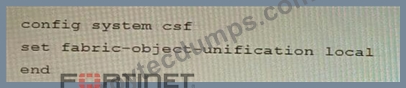
FGT_1 and FGT_3 are configured with the default setting. Which statement is true for the synchronization of fabric-objects?
- A. Objects from the root FortiGate will not be synchronized to any downstream FortiGate.
- B. Objects from the FortiGate FGT_2 will be synchronized to the upstream FortiGate.
- C. Objects from the root FortiGate will only be synchronized to FGT_3.
- D. Objects from the root FortiGate will only be synchronized to FGT__2.
Answer: C
Explanation:
https://docs.fortinet.com/document/fortigate/6.4.0/new-features/520820/improvements-to-synchronizing- objects-across-the-security-fabric-6-4-4
NEW QUESTION # 36
......
Download the Latest NSE8_812 Dump - 2025 NSE8_812 Exam Question Bank: https://pass4sure.troytecdumps.com/NSE8_812-troytec-exam-dumps.html