

GFMC Dumps PDF 2026 Program Your Preparation EXAM SUCCESS
Get Perfect Results with Premium GFMC Dumps Updated 117 Questions
AGA GFMC Exam Syllabus Topics:
| Topic | Details |
|---|---|
| Topic 1 |
|
| Topic 2 |
|
| Topic 3 |
|
| Topic 4 |
|
| Topic 5 |
|
NEW QUESTION # 56
The first step in assessing an agency's internal control program's compliance with applicable laws and regulations is to
- A. develop an inventory of the applicable laws and regulations.
- B. request a compliance review from the agency's chief legal officer.
- C. contact the legislature to secure its views on any areas of regulatory noncompliance.
- D. review legal actions against the agency for noncompliance with laws and regulations.
Answer: A
Explanation:
* First Step in Assessing Compliance:
* The first step in evaluating compliance is to develop acomprehensive inventoryof all applicable laws and regulations that the agency must follow.
* This ensures the assessment process is thorough and based on a clear understanding of the regulatory environment.
* Explanation of Answer Choices:
* A. Review legal actions against the agency for noncompliance with laws and regulations:
Important, but this comes later as part of identifying past compliance issues.
* B. Contact the legislature to secure its views on any areas of regulatory noncompliance:
Unnecessary for the initial step of compliance assessment.
* C. Develop an inventory of the applicable laws and regulations: Correct. This is the foundational step to ensure all relevant requirements are included in the assessment.
* D. Request a compliance review from the agency's chief legal officer: Incorrect. While legal advice may be helpful, it is not the starting point for compliance assessment.
:
GAO,Standards for Internal Control in the Federal Government (Green Book).
OMB Circular A-123,Management's Responsibility for Internal Control.
NEW QUESTION # 57
Under the control environment component of internal control, management should
- A. demonstrate a commitment to integrity and ethical values.
- B. establish and operate activities to monitor the internal control system.
- C. communicate quality information to achieve the entity's objectives.
- D. implement control activities through policies.
Answer: A
Explanation:
* Control Environment Component:
* The control environment is the foundation of an internal control system, setting the tone at the top.
* Demonstrating integrity and ethical values is the first principle of the control environment, as outlined in theCOSO Internal Control Framework.
* Explanation of Answer Choices:
* A. Demonstrate a commitment to integrity and ethical values: Correct. This is a foundational principle of the control environment.
* B. Implement control activities through policies: This relates to the "Control Activities" component, not the control environment.
* C. Communicate quality information to achieve the entity's objectives: This relates to the
"Information and Communication" component.
* D. Establish and operate activities to monitor the internal control system: This relates to the
"Monitoring Activities" component.
:
COSO,Internal Control - Integrated Framework.
GAO,Standards for Internal Control in the Federal Government (Green Book).
NEW QUESTION # 58
A city decides to invest in a new piece of equipment and wants to know how long it will take to recover the amount invested by using the payback analysis technique. The city uses the following assumptions in its analysis:
* The cost of the equipment is $500,000.
* The equipment will generate $200,000 in revenue per year.
* The variable costs of operating the equipment will be $100,000 per year.
* The depreciation on the equipment will be $20,000 per year.
How long will it take the city to recover the amount invested in the new equipment?
- A. Syears
- B. 6 years and 3 months
- C. 2 years and 6 months
- D. 2 years and 9 months
Answer: A
NEW QUESTION # 59
For financial audits, generally accepted auditing standards require that auditors accomplish all of the following tasks EXCEPT
- A. supervise any assistants.
- B. adequately plan the work.
- C. obtain sufficient appropriate audit evidence.
- D. make the audit report available to the public.
Answer: D
Explanation:
What Do Generally Accepted Auditing Standards (GAAS) Require for Financial Audits?
GAAS outlines specific requirements for auditors conducting financial audits, including:
* Adequately Planning the Work (Option A):Proper planning ensures that audits are efficient and thorough.
* Obtaining Sufficient, Appropriate Audit Evidence (Option C):This is critical to support the auditor' s opinion on the financial statements.
* Supervising Assistants (Option D):Supervising any audit staff ensures that work is performed in accordance with standards.
What Does GAAS Not Require?
* GAAS does not specifically require auditors to make the audit report available to the public (Option B).
While making reports available to the public may be required by other laws, regulations, or organizational policies, it is not a standard requirement under GAAS. The decision to make the report public often lies with the audited entity or governing bodies.
References and Documents:
* AICPA Statements on Auditing Standards (SAS):The foundational standards that define GAAS requirements.
* GAGAS (Yellow Book):While GAGAS may have additional reporting requirements, it does not mandate public access to the audit report unless stipulated by law.
NEW QUESTION # 60
The National Performance Management Advisory Commission established a comprehensive framework that incorporates performance measurement into the
- A. internal control plan.
- B. audit procedures.
- C. budget process.
- D. financial statements.
Answer: C
Explanation:
National Performance Management Advisory Commission Framework:
* TheNational Performance Management Advisory Commissiondeveloped a comprehensive framework to integrateperformance measurementinto government operations.
* One of its primary goals was to incorporate performance metrics into thebudget processto align resource allocation with program outcomes.
* This ensures that budgeting decisions are informed by program performance, improving efficiency and accountability.
Why the Budget Process?
* By linking performance to budgeting, governments can prioritize funding for programs that demonstrate effectiveness and reduce funding for underperforming initiatives.
Why Other Options Are Incorrect:
* A. Internal control plan:Internal controls focus on risk management, not incorporating performance measurement.
* B. Financial statements:Performance metrics are not reported in financial statements, which focus on financial position and results.
* C. Audit procedures:Audits verify financial accuracy and compliance but do not incorporate performance measurement.
References and Documents:
* National Performance Management Advisory Commission Report (2010):Recommends integrating performance measurement into the budget process.
* GAO Guide on Performance Budgeting:Explains how performance metrics inform budget decisions.
NEW QUESTION # 61
Management's need for real-time access to data is facilitated when
- A. data supporting dashboards are updated every quarter.
- B. data is represented visually and includes information that indirectly relates to the subject matter.
- C. the prior year's financial statement data underlies the management reports used to decide on future expenditures.
- D. complex data sets are available on demand, presented with minimal distractions.
Answer: D
Explanation:
Why Does Management Need Real-Time Data Access?
* Real-time access to data enables managers to make timely and informed decisions.
* Complex data setspresented clearly and concisely (with minimal distractions) allow decision-makers to focus on the critical insights necessary for strategic and operational planning.
Why Is Option D Correct?
* On-demand access ensures managers can retrieve updated data whenever needed. Presenting the data in a focused and distraction-free format facilitates quick comprehension and decision-making.
Why Other Options Are Incorrect:
* A. Visual representation with indirect information:Including unrelated data can overwhelm users and detract from effective decision-making.
* B. Dashboards updated quarterly:Quarterly updates do not meet the need for real-time access.
* C. Prior year's financial data:Decisions based solely on historical data are not responsive to real-time needs.
References and Documents:
* GAO Data Analytics and Visualization Framework:Stresses the importance of real-time, actionable, and distraction-free data for decision-making.
* AICPA Dashboard Guidelines:Recommends presenting complex data sets in a clear and accessible format for management use.
NEW QUESTION # 62
A program manager at a local agency needs to understand if program participation varies significantly from enrollment. The information changes daily. The best way to quickly analyze this would be to use
- A. dashboard.
- B. crosstab.
- C. text file.
- D. portable document format.
Answer: A
Explanation:
* Analyzing Participation and Enrollment Trends:
* Dashboards are tools that provide real-time visualizations of data, making them ideal for quickly analyzing trends such as program participation versus enrollment.
* They allow program managers to view up-to-date metrics and identify variances without manual data processing.
* Explanation of Answer Choices:
* A. Crosstab: While useful for comparing categorical data, crosstabs are static and less effective for real-time analysis.
* B. Portable document format (PDF): A PDF is a static file format, unsuitable for dynamic data analysis.
* C. Text file: Text files provide raw data but require additional processing, making them inefficient for quick analysis.
* D. Dashboard: Correct. Dashboards provide dynamic, real-time analytics, perfect for monitoring daily changes in participation and enrollment.
:
Association of Government Accountants (AGA),Data Visualization in Public Sector Management.
Government Performance Lab,Using Dashboards for Real-Time Program Management.
NEW QUESTION # 63
According to the GAO, internal control is a process used by management to
- A. set the tone at the top.
- B. develop a strategic plan.
- C. design an ERM system.
- D. help an entity achieve its objectives.
Answer: D
Explanation:
* Definition of Internal Control (According to GAO):
* Internal control is aprocess implemented by managementto provide reasonable assurance that the organization will achieve its objectives in:
* Operations(effectiveness and efficiency).
* Reporting(reliable and accurate financial and non-financial reporting).
* Compliance(adherence to laws and regulations).
* Explanation of Answer Choices:
* A. Help an entity achieve its objectives: Correct. This is the primary purpose of internal controls.
* B. Design an ERM system: Incorrect. Enterprise Risk Management (ERM) is broader than internal control and includes risk strategy and appetite.
* C. Set the tone at the top: Incorrect. While the tone at the top is part of the control environment, it is not the full scope of internal control.
* D. Develop a strategic plan: Incorrect. Internal control supports strategic plans but is not directly involved in developing them.
:
GAO,Standards for Internal Control in the Federal Government (Green Book).
COSO,Internal Control - Integrated Framework.
NEW QUESTION # 64
A material weakness in internal control over financial reporting is defined as a deficiency that
- A. did not allow management to perform their assigned responsibility to prevent, detect and correct misstatements in a timely manner.
- B. results in a material misstatement in other accompanying financial information.
- C. results in a misstatement to the basic financial statements.
- D. creates a reasonable possibility of a material misstatement to the financial statements that will not be detected in a timely manner.
Answer: D
Explanation:
Definition of a Material Weakness:
According to auditing standards, a material weakness in internal control over financial reporting is a deficiency or combination of deficiencies that creates a reasonable possibility of a material misstatement in the financial statements that will not be prevented or detected on a timely basis.
Key Characteristics of a Material Weakness:
* Reasonable Possibility:The likelihood of a misstatement is more than remote but less than certain.
* Material Misstatement:The error or omission could impact the decisions of users relying on the financial statements.
* Timely Detection:The deficiency allows errors to go undetected for an extended period, potentially affecting financial statement reliability.
Why Other Options Are Incorrect:
* A.A misstatement in the basic financial statements may result from a material weakness, but the definition focuses on the reasonable possibility, not the actual result.
* B.A material weakness impacts the financial statements, not "other accompanying financial information."
* C.While timely detection is part of the issue, the definition focuses on the reasonable possibility of a misstatement, not management's inability to perform specific duties.
References and Documents:
* GAAS (AICPA SAS No. 115):Provides the formal definition of material weaknesses and guidance for auditors in evaluating control deficiencies.
* COSO Framework:Emphasizes the need for effective internal controls to mitigate material misstatement risks.
NEW QUESTION # 65
Using Benford Digital Analysis, an auditor can identify potential fraud when
- A. a large contract is awarded to the director's close relative.
- B. a large number of contracts are awarded to one vendor.
- C. an employee receives kickbacks from real estate developers.
- D. a higher-than-expected number of payment amounts to one vendor start with the number three.
Answer: D
Explanation:
* Benford's Law and Fraud Detection:
* Benford's Lawis a statistical principle that predicts the frequency of leading digits in naturally occurring datasets.
* Deviations from the expected distribution (e.g., a higher-than-expected frequency of a specific leading digit) can indicate manipulation or fraud.
* For example, if too many payments start with the number "3," it suggests potential tampering.
* Explanation of Answer Choices:
* A. A higher-than-expected number of payment amounts to one vendor start with the number three: Correct. This aligns with how Benford's Law is used to detect anomalies in numerical data.
* B. A large number of contracts are awarded to one vendor: While concerning, this is not related to Benford's Law.
* C. A large contract is awarded to the director's close relative: This indicates a conflict of interest but is unrelated to Benford's Law.
* D. An employee receives kickbacks from real estate developers: This is fraud but cannot be identified using Benford's Law.
:
Association of Certified Fraud Examiners (ACFE),Fraud Detection Using Benford's Law.
GAO,Fraud Risk Management Framework.
NEW QUESTION # 66
Efficient inventory management will result in
- A. high total asset turnover.
- B. high write-offs of obsolete inventory.
- C. a low inventory turnover ratio.
- D. fewer instances of work stoppage.
Answer: D
Explanation:
What Is Efficient Inventory Management?
* Efficient inventory management ensures that an organization has the right amount of inventory at the right time to meet operational needs without overstocking or understocking.
* Proper inventory management minimizes disruptions to operations, including work stoppages due to lack of necessary materials or supplies.
Why Is Fewer Instances of Work Stoppage the Correct Answer?
* Efficient inventory management ensures that required inventory is available when needed, reducing the risk of work delays or stoppages caused by inventory shortages.
Why Other Options Are Incorrect:
* A. A low inventory turnover ratio:A low turnover ratio often indicates overstocking or slow-moving inventory, which is not a sign of efficiency.
* B. High write-offs of obsolete inventory:Efficient management reduces obsolete inventory, leading to fewer write-offs, not more.
* D. High total asset turnover:While efficient inventory management may contribute to overall asset efficiency, it does not directly result in a high total asset turnover ratio.
References and Documents:
* GAO Guide on Inventory Management:Emphasizes the role of inventory management in avoiding operational disruptions.
* Best Practices for Inventory Management (AGA):Highlights reduced work stoppages as a key benefit of effective inventory control.
NEW QUESTION # 67
What is the first step on performing a risk assessment under the COSO Internal Control Framework?
- A. setting risk tolerance levels
- B. defining internal control objectives
- C. identification of risks
- D. review of prior audit findings
Answer: B
Explanation:
* Risk Assessment Under COSO Framework:
* The first step in a COSO-based risk assessment is defining internal control objectives. This establishes what the organization aims to achieve, providing a framework for identifying risks and ensuring controls align with objectives.
* Risk assessment focuses on evaluating the likelihood and impact of risks that could hinder these objectives.
* Explanation of Answer Choices:
* A. Identification of risks: Identifying risks follows the definition of internal control objectives.
* B. Defining internal control objectives: Correct. Objectives must be defined first to provide a basis for identifying and assessing risks.
* C. Review of prior audit findings: Important, but it's not the starting point for a risk assessment under COSO.
* D. Setting risk tolerance levels: This occurs later, after risks have been identified and evaluated.
:
COSO,Internal Control - Integrated Framework.
GAO,Standards for Internal Control in the Federal Government (Green Book).
NEW QUESTION # 68
As a way to ensure fiduciary responsiblity, a government entity should include which of the following in its investment policy?
- A. permissible and non-permissible investment securities
- B. prices and performance of its investment securities
- C. key and non-key investment security controls
- D. historical allocations of investment securities
Answer: A
Explanation:
Why Include Permissible and Non-Permissible Investment Securities?
* Aninvestment policyoutlines the guidelines and restrictions for managing an entity's investments, ensuring compliance with laws and protecting public funds.
* Listingpermissible(e.g., government bonds, treasury securities) andnon-permissibleinvestments ensures clarity about what the entity can and cannot invest in, helping to mitigate risk and maintain fiduciary responsibility.
Why Other Options Are Incorrect:
* A. Prices and performance of investment securities:This information is important for monitoring investments but does not belong in the policy itself.
* C. Historical allocations of investment securities:Historical data informs decision-making but is not relevant to the rules governing investments.
* D. Key and non-key investment security controls:While controls are critical, they are part of the implementation process, not the investment policy.
References and Documents:
* GAO Investment Policy Guidelines:Recommends specifying permissible investments to ensure fiduciary responsibility.
* GFOA Best Practices in Investment Management:Emphasizes clear investment guidelines in the policy.
NEW QUESTION # 69
Compliance reporting, under government auditing standards, identifies all of the following components EXCEPT
- A. the scope of the compliance testing.
- B. review of major internal control cycles.
- C. areas of noncompliance.
- D. the auditor's responsibility for tests of compliance.
Answer: B
Explanation:
* Compliance Reporting Under Government Auditing Standards (GAS):
* GAS requires auditors to assess compliance with applicable laws, regulations, contracts, and grant agreements during audits.
* Compliance reporting typically includes:
* Identifying areas of noncompliance.
* Describing the auditor's responsibility for compliance testing.
* Outlining the scope of compliance testing.
* Explanation of Answer Choices:
* A. Areas of noncompliance: Included in compliance reporting to highlight where the entity failed to meet requirements.
* B. The auditor's responsibility for tests of compliance: GAS requires auditors to clarify their role in compliance testing.
* C. Review of major internal control cycles: Correct. While internal controls may be assessed, reviewing "major internal control cycles" is not a direct component of compliance reporting.
* D. The scope of the compliance testing: GAS mandates that the scope of testing be disclosed in the compliance report.
:
GAO,Government Auditing Standards (Yellow Book).
AICPA,Compliance Reporting Guidance for Government Audits.
NEW QUESTION # 70
In a performance aygit, due professional care is used to
- A. present the findings in accordance with GAAP.
- B. set materiality of financial statements.
- C. obtain sufficient and competent evidence.
- D. determine scope.
Answer: C
Explanation:
* Performance Audit Overview:
* A performance audit focuses on evaluating the economy, efficiency, and effectiveness of government programs or activities.
* Due professional care is a requirement inGovernment Auditing Standards (Yellow Book), ensuring auditors perform their duties responsibly and with professional judgment.
* Key Requirement: Sufficient and Competent Evidence:
* Auditors must collect sufficient and reliable evidence to support their findings, conclusions, and recommendations. This is the cornerstone of "due professional care."
* Explanation of Answer Choices:
* A. Obtain sufficient and competent evidence: Correct. This ensures audit findings are supported by reliable, documented evidence.
* B. Determine scope: While part of audit planning, it is not directly related to due professional care.
* C. Set materiality of financial statements: This applies to financial audits, not performance audits.
* D. Present the findings in accordance with GAAP: GAAP is not a requirement for performance audits.
:
GAO,Government Auditing Standards (Yellow Book).
Association of Government Accountants (AGA),Performance Auditing Practices.
NEW QUESTION # 71
When creditworthiness is a criterion for government loan approval, loan applicants must provide
- A. a satisfactory history of repaying debt.
- B. sufficient capitalization.
- C. a credit rating from a major bank.
- D. a promise to pay interest at the government borrowing rate.
Answer: A
Explanation:
Creditworthiness and Loan Approval:
* When creditworthiness is a criterion for government loans, the applicant must demonstrate a satisfactory history of repaying debt, as this reflects their ability to fulfill repayment obligations in the future.
Why a Satisfactory History Is Required:
* Past repayment behavior is considered the best indicator of future performance. Government agencies prioritize reducing the risk of defaults by ensuring applicants have a proven history of managing debt responsibly.
Why Other Options Are Incorrect:
* A. A credit rating from a major bank:While a credit rating is helpful, it is not typically required for government loans. Instead, creditworthiness is evaluated based on repayment history and other financial factors.
* C. Sufficient capitalization:This is important for business loans, but it does not address creditworthiness.
* D. A promise to pay interest at the government borrowing rate:A promise is not sufficient to establish creditworthiness.
References and Documents:
* OMB Circular A-129:Requires agencies to assess creditworthiness before granting loans.
* GAO Loan Management Guide:Highlights repayment history as a key criterion for loan approval.
NEW QUESTION # 72
Pay.gov is an example of
- A. a data warehouse system.
- B. a zero-balance account.
- C. an electronic lockbox.
- D. a concentration system.
Answer: C
Explanation:
What Is Pay.gov?
* Pay.govis anelectronic lockbox systemmanaged by the U.S. Department of the Treasury. It allows federal agencies to collect payments electronically, improving efficiency and reducing the time and cost associated with manual payment processing.
* It supports online payments for taxes, fees, and other government-related obligations.
Why Is It an Electronic Lockbox?
* Pay.gov consolidates and processes payments on behalf of federal agencies, similar to how a lockbox service processes payments for private businesses.
Why Other Options Are Incorrect:
* A. Zero-balance account:This refers to a type of bank account that maintains a balance of zero by automatically transferring funds as needed, unrelated to Pay.gov's purpose.
* B. Concentration system:Refers to pooling funds from multiple accounts into one central account, not payment processing.
* D. Data warehouse system:A data warehouse stores and organizes large amounts of data for analysis, unrelated to payment collection.
References and Documents:
* U.S. Treasury Pay.gov Website:Describes Pay.gov as an electronic lockbox for federal payment processing.
* GAO Financial Management Systems Guide:Highlights the role of electronic lockboxes like Pay.gov in improving efficiency.
NEW QUESTION # 73
Based on the data below, what can be concluded about outsourcing print job?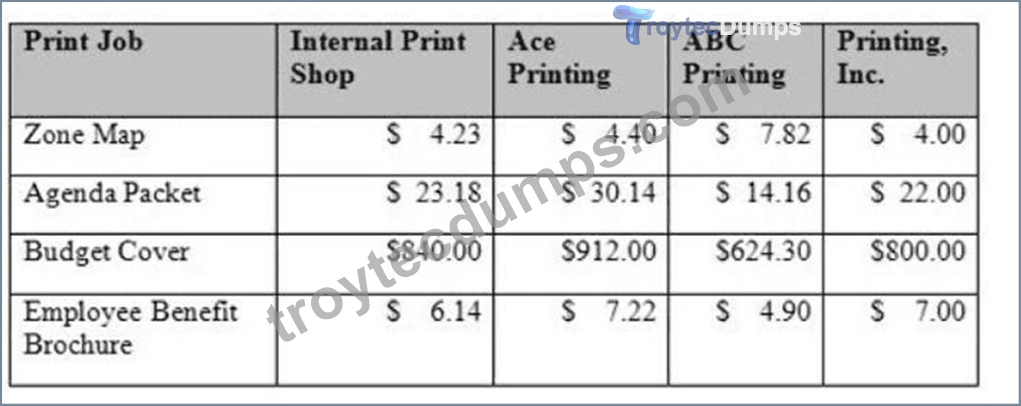
- A. It is better to keep the printing in-house.
- B. Outsourcing printing is feasible.
- C. Outsourcing printing is necessary.
- D. ABC Printing should be awarded the outsourcing contract.
Answer: B
Explanation:
* Understanding the Scenario:The table compares the costs of four printing jobs performed by an
"Internal Print Shop" versus three external vendors (Ace Printing, ABC Printing, and Printing, Inc.).
Each vendor's pricing varies by print job type. The task is to evaluate whether outsourcing (hiring external vendors) is a reasonable alternative to keeping the work in-house.
* Key Considerations in Outsourcing:According to governmental accounting principles and budgeting practices outlined by theAssociation of Government Accountants (AGA), the decision to outsource should consider:
* Cost-effectiveness: Does outsourcing reduce costs without compromising quality or service delivery?
* Operational efficiency: Can outsourcing free up internal resources for other priorities?
* Comparative pricing: How do external vendor rates compare to internal costs for identical services?
* Analysis of the Print Jobs:Let's break down the cost comparison for each print job:
* Zone Map:Internal cost = $4.23.Cheapest vendor = Printing, Inc., at $4.00.Outsourcing is cheaper for this job.
* Agenda Packet:Internal cost = $23.18.Cheapest vendor = Printing, Inc., at $22.00.Outsourcing is cheaper for this job.
* Budget Cover:Internal cost = $840.00.Cheapest vendor = ABC Printing, at $624.30.Outsourcing is significantly cheaper for this job.
* Employee Benefit Brochure:Internal cost = $6.14.Cheapest vendor = ABC Printing, at $4.90.
Outsourcing is cheaper for this job.
* Conclusion Based on Analysis:
* Across all four print jobs, the lowest-cost external vendor always beats the Internal Print Shop's costs.
* From abudgetary perspective, outsourcing is feasible as it offers cost savings across all jobs.
* Why Not A, C, or D?:
* Option A(Keep printing in-house): Incorrect, as in-house costs are consistently higher than the cheapest external vendor.
* Option C(Outsourcing is necessary): Incorrect, as feasibility doesn't mean necessity; internal printing is still an option if other factors (like quality or control) outweigh costs.
* Option D(Award contract to ABC Printing): Incorrect, since the best vendor depends on the job (e.g., Printing, Inc. is cheaper for Zone Map and Agenda Packet).
:
Association of Government Accountants (AGA),Government Financial Manager Certification Study Guide:
Budgeting, Cost Accounting, and Auditing Principles.
Government Finance Officers Association (GFOA),Best Practices in Outsourcing and Procurement.
Federal Accounting Standards Advisory Board (FASAB),Cost Accounting Standards for Governmental Operations.
NEW QUESTION # 74
Performance measures that relate program inputs to program outcomes are called
- A. cost-effectiveness measures.
- B. efficiency measures.
- C. activity measures.
- D. process measures.
Answer: A
Explanation:
* Definition of Cost-Effectiveness Measures:
* Cost-effectiveness measures assess therelationship between inputs (resources used)and outcomes (results achieved)to determine whether a program delivers value for the resources invested.
* Explanation of Answer Choices:
* A. Efficiency measures: Incorrect. These relate inputs to outputs, focusing on how efficiently resources are used to produce services, but not directly tied to outcomes.
* B. Process measures: Incorrect. These measure activities or steps within a program but do not assess outcomes.
* C. Cost-effectiveness measures: Correct. These directly link inputs to outcomes, measuring the program's effectiveness in achieving its objectives relative to costs.
* D. Activity measures: Incorrect. These track the level of activity or effort but not outcomes or effectiveness.
:
GASB,Performance Measurement and Reporting for Government Programs.
GAO,Best Practices in Measuring Program Effectiveness.
NEW QUESTION # 75
......
GFMC PDF Dumps Extremely Quick Way Of Preparation: https://pass4sure.troytecdumps.com/GFMC-troytec-exam-dumps.html