

Free 300-745 Sample Questions and 100% Cover Real Exam Questions (Updated 73 Questions)
Download Real Cisco 300-745 Exam Dumps Test Engine Exam Questions
Cisco 300-745 Exam Syllabus Topics:
| Topic | Details |
|---|---|
| Topic 1 |
|
| Topic 2 |
|
| Topic 3 |
|
| Topic 4 |
|
NEW QUESTION # 42
Refer to the exhibit.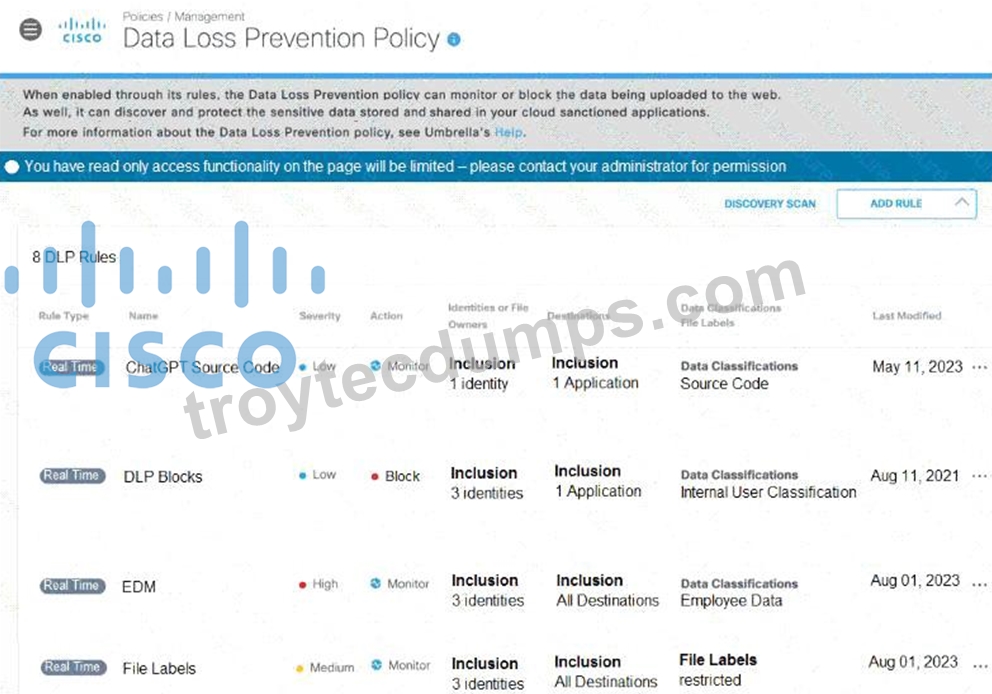
A software developer noticed that the application source code had been found on the internet. To avoid such an incident from happening again, the developer applied a DLP policy to prevent from uploading source code into generative AI tool like ChatGPT. When testing the policy, the developer noticed that it is still possible for the source code to be uploaded. Which action must the developer take to prevent this issue?
- A. Move the ChatGPT Source Code rule to the bottom.
- B. Modify the data classifications.
- C. Change the DLP action from Monitor to Block.
- D. Enable the rule.
Answer: C
Explanation:
In the provided exhibit of theCisco Data Loss Prevention (DLP) Policyinterface (likely within Cisco Umbrella or a similar cloud security gateway), the reason for the policy's failure to stop the upload is clearly visible in the "Action" column. The rule named"ChatGPT Source Code"is currently configured with the action set toMonitor.
According to theCisco SDSI v1.0objectives regarding application and data security, theMonitoraction is designed for visibility and auditing. It allows the traffic to pass through while generating a log entry for security analysts to review. This is often used during an initial "discovery" phase to understand how data is moving without disrupting business processes. However, to fulfill the requirement ofpreventingthe unauthorized upload of sensitive data-such as application source code-the policy must be enforcement- centric.
By selectingOption D, the developer changes the action from "Monitor" toBlock. In "Block" mode, the DLP engine will actively intercept the web request to ChatGPT, inspect the content for "Source Code" classifications, and drop the connection if a match is found, thereby preventing the data from leaving the corporate environment. While moving rules (Option B) can resolve conflicts if a "Block" rule is superseded by an "Allow" rule higher in the list, the primary issue here is the non-restrictive action of the specific rule itself. Modifying data classifications (Option C) is unnecessary if the engine is already correctly identifying the source code, as evidenced by the successful monitoring logs mentioned in the scenario. Changing the action to Block is the definitive step to ensure data integrity and prevent intellectual property theft.
NEW QUESTION # 43
A manufacturing company experienced a security breach that resulted in sales data being compromised. An engineer participating in the investigation must identify who logged into the sales system during the affected period. Which approach must be used to gather the information?
- A. SNMP
- B. NACM
- C. PKI
- D. AAA
Answer: D
Explanation:
AAA (Authentication, Authorization, and Accounting) provides accounting logs that record who logged in, when, and from where. During an investigation, these logs allow the security team to trace user logins to the sales system and identify who accessed it during the breach period.
NEW QUESTION # 44
A video game company identified a potential threat of a SYN flood attack, which could disrupt the online gaming services and impact user experience. The attack can overwhelm network resources by exploiting the TCP handshake process, leading to server unavailability and degraded performance. To safeguard the company's infrastructure and ensure uninterrupted service, it is essential to enhance the security measures in place. The company must implement a solution that manages and mitigates the risk of such network-based attacks. Which security product must be implemented to mitigate similar risks?
- A. Cisco Umbrella
- B. Cisco Secure Firewall
- C. Cisco Web Security Appliance
- D. Cisco Secure Endpoint
Answer: B
Explanation:
A SYN flood attack is a classic Denial-of-Service (DoS) technique that exploits the TCP three-way handshake. By sending a massive volume of SYN packets without completing the handshake, the attacker exhausts the target server's connection table.Cisco Secure Firewall(formerly Firepower) is the architectural component designed to mitigate these network-layer threats.
Cisco Secure Firewall utilizes features such asTCP InterceptandSYN Cookiesto defend against these attacks. When a SYN flood is detected, the firewall can act as a proxy for the handshake, only passing the completed connection to the backend server once the three-way handshake is verified. This prevents the server's resources from being overwhelmed by "half-open" connections.
In contrast,Cisco Web Security Appliance(Option A) is focused on web-based (HTTP/HTTPS) threats and proxying, not low-level TCP flood mitigation.Cisco Umbrella(Option B) primarily provides DNS-layer security and Secure Internet Gateway (SIG) services, which are ineffective against a direct SYN flood targeting an on-premises or cloud-hosted gaming server.Cisco Secure Endpoint(Option C) protects individual hosts from malware but cannot protect the network infrastructure or the server's TCP stack from being saturated by high-volume flood traffic. Consequently, Cisco Secure Firewall is the essential product for managing and mitigating these infrastructure-level network attacks.
========
NEW QUESTION # 45
Considering recent cybersecurity threats, a company wants to improve the process for identifying, assessing, and managing risks with a comprehensive and holistic approach. Which framework must be used to meet these requirements?
- A. HIPPA
- B. NIST SP 800-37
- C. GDPR
- D. MITRE CAPEC
Answer: B
Explanation:
For an organization seeking a "comprehensive and holistic approach" to risk management, theNIST SP 800-
37 (Risk Management Framework - RMF)is the industry-standard recommendation. The RMF provides a structured, seven-step process for managing security and privacy risk: Prepare, Categorize, Select, Implement, Assess, Authorize, and Monitor.
According to the Cisco SDSI objectives, the NIST RMF allows organizations to align their security controls with their business goals and risk tolerance. It moves security beyond a simple "checklist" and into a continuous lifecycle of improvement.HIPAA(Option A) andGDPR(Option D) are regulatory mandates focused on specific data types (Health and Privacy, respectively) rather than a general framework for all organizational risks.MITRE CAPEC(Option B) is a dictionary of attack patterns used for technical threat modeling, not a holistic risk management process. By adopting NIST SP 800-37, a company ensures that its security infrastructure is designed and maintained based on a rigorous assessment of the current threat landscape and organizational requirements, fulfilling the core requirements of the "Risk, Events, and Requirements" domain.
NEW QUESTION # 46
Employees in a healthcare organization could not access their devices when they returned to work after the weekend. The security team discovered that a threat actor had encrypted the devices. Which security solution would mitigate the risk in future?
- A. data loss prevention
- B. password policy enforcement
- C. endpoint detection and response
- D. network configuration management
Answer: C
Explanation:
Endpoint Detection and Response (EDR) provides continuous monitoring, detection, and automated response to suspicious activity on devices. It can identify and stop ransomware attacks before encryption occurs, mitigating the risk of device lockouts in the future.
NEW QUESTION # 47
A restaurant distribution center recently suffered a password spray attack targeting the Cisco Secure Firepower Threat Defense VPN headend. The attack attempts to gain unauthorized access by trying common passwords across many accounts. The attack poses a significant security threat to the organization's remote access infrastructure. To enhance the security of VPN setup and minimize the risk of similar attacks in the future, the IT security team must implement effective mitigation measures. Which technique effectively reduces the risk of this type of attack?
- A. Enable AAA authentication for the DefaultWEBVPN and DefaultRAGroup Connection Profiles.
- B. Change the AAA authentication method from RADIUS to TACACS+.
- C. Disable group aliases in the connection profiles.
- D. Implement an access list to block addresses from the previous password spray attack.
Answer: A
Explanation:
Enabling AAA authentication on the default connection profiles ensures that all VPN access attempts must go through strong authentication. This directly mitigates password spray attacks by enforcing centralized authentication controls, enabling account lockout, and supporting additional protections such as multifactor authentication.
NEW QUESTION # 48
Refer to the exhibit.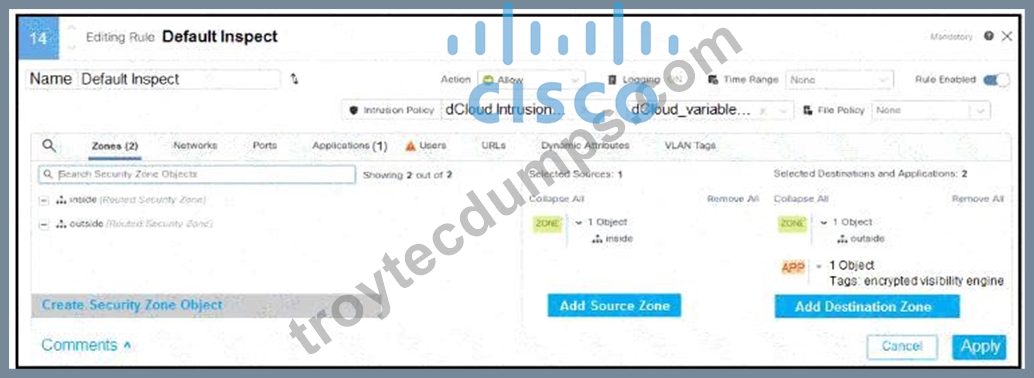
In addition to SSL decryption, which firewall feature allows malware to be blocked?
- A. File Inspection
- B. DLP
- C. SSL Offloading
- D. URL Filtering
Answer: A
Explanation:
Based on the provided exhibits, the correct firewall feature for blocking malware in this context isFile Inspection.
Inimage_4c047c.png, we see a Cisco Secure Firewall Access Control Policy rule named "Default Inspect".
This rule is configured to allow traffic from the "inside" zone to the "outside" zone while applying deep packet inspection. Crucially, the configuration includes aFile Policyfield, which is the mechanism used to perform malware analysis and file disposition lookups. By associating a File Policy with an Access Control rule, the firewall can inspect files as they transit the network, calculate their SHA-256 hash, and query the Cisco Collective Security Intelligence cloud to determine if the file is malicious, clean, or unknown.
The evidence of this feature in action is found inimage_4b1ebe.png, which shows theCisco Secure Endpoint (formerly AMP for Endpoints) Device Trajectory. The "Activity Details" pane specifically identifies a malicious file (iodnxvg.exe) categorized asW32.DFC.MalParent. While the log notes the file was not quarantined because it was in "audit only mode," the underlying technology performing the detection isFile Inspection. This feature provides the necessary visibility into the contents of encrypted or unencrypted data streams to identify and-when properly configured in a "Protect" or "Block" mode-stop the execution of malware. This aligns with the Cisco SDSI objective of building a layered defense that combines perimeter traffic control with granular file-level security.
NEW QUESTION # 49
In preparation for an upcoming security audit, a metal production company decided to enhance the security of container-based services running in a Kubernetes environment. The company wants to ensure that all communications between applications and services are encrypted. The administrator plans to implement mTLS service between application and services to secure the data exchanges. Given the need to manage encryption at scale and maintain efficient communication across the cluster, which network transport technology must be employed?
- A. Kubernetes network policies
- B. Service Mesh
- C. load balancing
- D. ingress controller
Answer: B
Explanation:
In modern cloud-native architectures, managing security for hundreds of microservices manually is unfeasible. To implementmutual TLS (mTLS)at scale within a Kubernetes cluster, aService Mesh(such as Istio or Cisco Service Mesh Manager) is the architectural solution of choice. A service mesh provides a dedicated infrastructure layer for handling service-to-service communication without requiring changes to the application code itself.
The service mesh operates by deploying a "sidecar" proxy alongside every service instance. These proxies handle the heavy lifting of identity verification, certificate rotation, and the establishment of encrypted tunnels. This ensures that every data exchange is encrypted and that services only communicate with authenticated peers. While anIngress Controller(Option A) manages traffic entering the cluster andLoad Balancing(Option B) distributes traffic, neither provides the granular, internal encryption framework required for pod-to-pod mTLS.Kubernetes Network Policies(Option C) act as a distributed firewall to allow or deny traffic based on IP/Port but do not handle encryption or cryptographic identity. By choosing a Service Mesh, the company satisfies the audit requirement for end-to-end encryption and pervasive visibility into the application's communication flow, aligning with Cisco's design principles for secure, scalable microservices.
========
NEW QUESTION # 50
A company has been facing recurring issues with SQL injection vulnerabilities affecting the products, leading to significant disruptions for customers. To address the security concerns proactively, the company wants to integrate a tool into the CI/CD pipeline. The tool must be capable of identifying vulnerabilities such as SQL injection early in the development process, which allows developers to rectify issues before the code is deployed. Which solution must be implemented to meet the requirement?
- A. Dynamic Application Security Testing tools, such as OWASP ZAP, Veracode, Burp Suite
- B. workflow automation tools, such as GitHub Actions, Azure
- C. Static Application Security Testing tools, such as Checkmarx, Fortify, SonarQube
- D. build log observability tools, such as Splunk, Datadog
Answer: C
Explanation:
Static Application Security Testing (SAST) tools analyze source code during the development and build phases of the CI/CD pipeline. They can identify coding flaws such as SQL injection vulnerabilities early, allowing developers to fix issues before deployment.
NEW QUESTION # 51
A global energy company moved a monolithic application from the data center to public cloud. Over time, the company added many capabilities to the application, and it is now difficult for the application team to scale it.
The application owner decided to modernize the application by moving to a Kubernetes cluster. However, he wants to ensure that the new application architecture provides a container network interface that is scalable, offers options for cloud-native security, and helps with visibility and observability. Which solution must be used to accomplish the task?
- A. Cilium
- B. ingress gateway
- C. ENI
- D. security group
Answer: A
Explanation:
In the realm of modern application security and Kubernetes networking,Ciliumhas emerged as the industry- standardContainer Network Interface (CNI)that leverageseBPF (extended Berkeley Packet Filter) technology. For a global company modernizing a monolithic app into microservices, Cilium provides the required scalability and high-performance networking by operating directly within the Linux kernel.
Unlike traditionalSecurity Groups(Option A) which are often limited to IP-based rules at the cloud infrastructure level, orENIs(Option C) which are AWS-specific hardware interfaces, Cilium providesidentity- awaresecurity. It understands Kubernetes labels and metadata, allowing for granular Layer 7 policy enforcement. Furthermore, Cilium addresses the "visibility and observability" requirement through itsHubble component, which provides deep insights into network flows, application dependencies, and security events without the overhead of traditional sidecar proxies. AnIngress Gateway(Option D) manages external traffic entering the cluster but does not provide the comprehensive pod-to-pod networking, eBPF-based security, or internal observability that a CNI like Cilium offers. Designing with Cilium aligns with Cisco's focus on cloud- native security and the use of eBPF for distributed firewalling and telemetry in modern application environments.
========
NEW QUESTION # 52
A financial company is in the process of upgrading network access across the entire company. The solution must ensure: least privilege access control access across different network segments and increased security for employees. Which solution approach must the company take?
- A. NetFlow
- B. SNMP
- C. RBAC
- D. PKI
Answer: C
Explanation:
In the architecture of a modern secure infrastructure, achievingleast privilegeis a foundational requirement, especially for a financial institution where data sensitivity is high.Role-Based Access Control (RBAC)is the specific methodology used to restrict network access based on the roles of individual users within an enterprise. By implementing RBAC, the security team can ensure that employees only have access to the specific network segments and resources necessary for their job functions, effectively minimizing the internal attack surface.
Within the Cisco Security ecosystem, RBAC is often operationalized through tools likeCisco Identity Services Engine (ISE)usingScalable Group Tags (SGTs). Instead of relying on static IP addresses or complex Access Control Lists (ACLs) that are difficult to maintain across different segments, RBAC allows for dynamic policy enforcement. For example, a "Financial Auditor" role would automatically be granted access to the accounting segment but blocked from the development segment, regardless of where they plug into the network. WhilePKI(Option C) provides strong authentication and encryption, andNetFlow(Option A) provides visibility, neither inherently defines the "least privilege" permission structure. RBAC is the architectural approach that directly maps business requirements to technical access policies, ensuring that security is maintained across segmented environments as required by the Cisco SDSI objectives for secure infrastructure design.
========
NEW QUESTION # 53
Refer to the exhibit. A retail company recently deployed a file inspection feature using secure endpoint. The file inspection must detect and prevent the execution of malicious files on machines. During testing, logs showed that certain malicious files are still being executed despite the presence of the security measure. To understand why the threats are not being blocked, it is essential to investigate the configuration of secure endpoint policies. Which configuration is allowing the files to execute?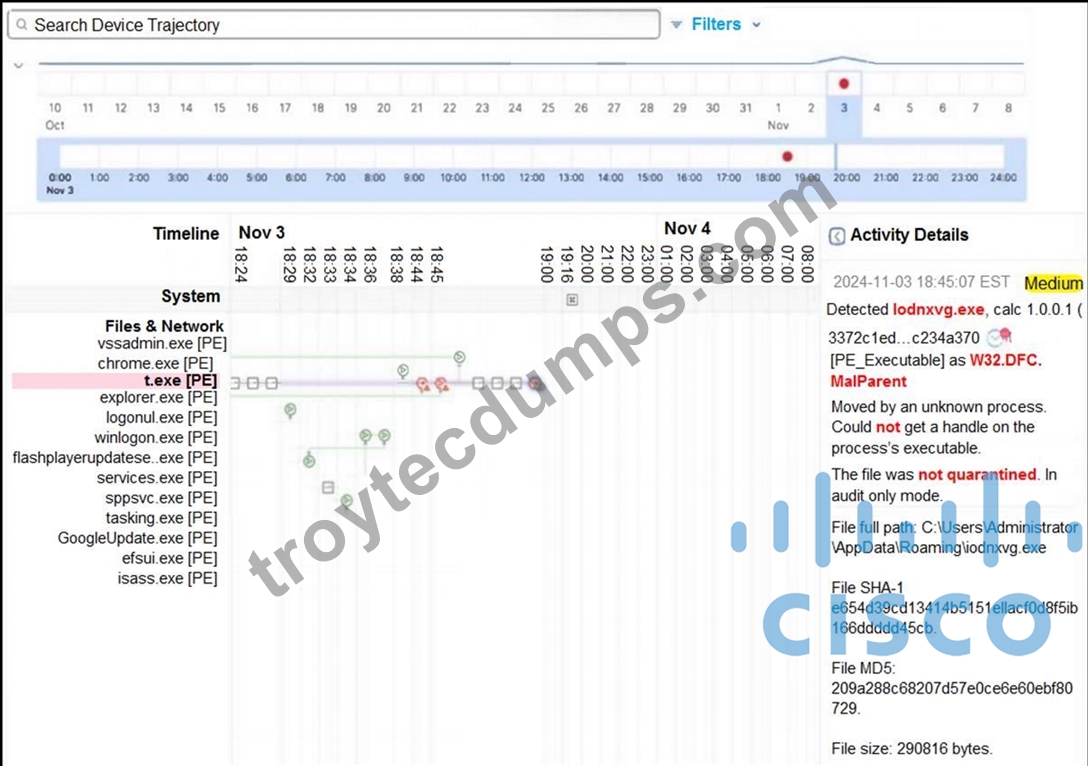
- A. Policy must block the network connections.
- B. Files are not malicious.
- C. Policy rule is in audit mode.
- D. Policy rule is disabled.
Answer: C
Explanation:
The exhibit shows that the malicious file was detected but not quarantined with the note "In audit only mode." This indicates that the secure endpoint policy was set to audit mode, which only logs detections instead of blocking execution. To prevent malicious files from running, the policy must be switched from audit mode to enforcement (block) mode.
NEW QUESTION # 54
A company has been facing recurring issues with SQL injection vulnerabilities affecting the products, leading to significant disruptions for customers. To address the security concerns proactively, the company wants to integrate a tool into the CI/CD pipeline. The tool must be capable of identifying vulnerabilities such as SQL injection early in the development process, which allows developers to rectify issues before the code is deployed. Which solution must be implemented to meet the requirement?
- A. Dynamic Application Security Testing tools, such as OWASP ZAP, Veracode, Burp Suite
- B. workflow automation tools, such as GitHub Actions, Azure
- C. Static Application Security Testing tools, such as Checkmarx, Fortify, SonarQube
- D. build log observability tools, such as Splunk, Datadog
Answer: C
Explanation:
In the framework of theDesigning Cisco Security Infrastructure (300-745 SDSI)curriculum, the "Shift- Left" security strategy is fundamental to modern DevSecOps. To identify vulnerabilities like SQL injection at the earliest possible stage-specifically before the code is even compiled or deployed-Static Application Security Testing (SAST)is the required solution. SAST tools analyze the application's source code, byte code, or binaries without actually executing the program.
By integrating SAST tools like Checkmarx or SonarQube into the CI/CD pipeline, the security team can automate the scanning of every code commit or pull request. These tools use sophisticated algorithms to trace data flows and identify dangerous patterns, such as user-controlled input being concatenated directly into SQL queries without proper sanitization or parameterization. This proactive approach allows developers to receive immediate feedback within their native workflow, enabling them to fix security flaws before they progress into later, more expensive stages of the development lifecycle.
In contrast,Dynamic Application Security Testing (DAST)(Option D) requires a running instance of the application and typically occurs much later in the pipeline, such as during the testing or staging phase. While DAST is excellent for finding runtime vulnerabilities, it does not meet the requirement of identifying issues
"early in the development process" as effectively as SAST.Build log observability tools(Option B) and workflow automation platforms(Option C) provide infrastructure and visibility but do not possess the specialized engine required to perform deep code analysis for application-layer vulnerabilities like SQL injection. Implementing SAST ensures that security is a foundational element of the code-writing phase, aligning with Cisco's vision for a secure, automated software supply chain.
NEW QUESTION # 55
A furniture company recently discovered that the endpoint detection and response configuration flagged several malicious files on company-managed laptops. The company must enhance security to prevent known malicious files from being delivered to the network and endpoints. The new solution must enhance the company's ability to inspect and filter incoming traffic effectively. Which security product must be used to accomplish this goal?
- A. next-generation firewall
- B. eBPF
- C. host-based firewall
- D. traditional firewall
Answer: A
Explanation:
While Endpoint Detection and Response (EDR) is excellent at catching threats that have already reached a device, the objective here is topreventthose files from being delivered in the first place by enhancing the inspection of incoming traffic. ANext-Generation Firewall (NGFW)is the correct architectural choice for this requirement because it operates at the network perimeter (or between segments) and provides deep packet inspection (DPI) far beyond the capabilities of a traditional firewall.
A Cisco Secure Firewall (NGFW) integrates multiple security services into a single platform, including Intrusion Prevention Systems (IPS), Application Visibility and Control (AVC), andAdvanced Malware Protection (AMP). When malicious files are sent toward the network, the NGFW can identify them by their signature or behavior and block the transfer before the file ever reaches the internal infrastructure or endpoints. This effectively "cleans" the traffic stream at the gate.
Atraditional firewall(Option B) lacks the application-layer visibility needed to identify malicious file content, as it primarily filters based on IP and port. Ahost-based firewall(Option C) filters traffic at the individual device level, which is a late-stage defense rather than a network delivery prevention tool.eBPF (Option D) is a high-performance kernel technology used for observability and distributed filtering but is not a standalone "security product" used for perimeter traffic inspection in this context. Implementing an NGFW aligns with the Cisco SAFE principle of providing a layered defense that blocks threats as far from the critical assets as possible.
========
NEW QUESTION # 56
What is the primary benefit of conducting a root cause analysis after a security incident?
- A. Validate OSI model compliance
- B. Improve FTP throughput
- C. Enable compliance with NTP standards
- D. Drive design improvements to prevent recurrence
Answer: D
Explanation:
Root cause analysis focuses on identifying the underlying cause of a security incident. This enables organizations to improve system design, controls, or processes so that similar incidents do not happen again, rather than only fixing symptoms.
NEW QUESTION # 57
An IT company experienced the spread of malicious content between user endpoints, which impacted business critical resources. The company wants to implement a solution to control communication between individual endpoints on the network. Which approach achieves the goal?
- A. TrustSec
- B. profiling
- C. posture
- D. RADIUS
Answer: A
Explanation:
Cisco TrustSec enables software-defined segmentation by assigning Security Group Tags (SGTs) to endpoints and enforcing communication policies. This allows granular control of traffic between individual endpoints, preventing the spread of malicious content across the network.
NEW QUESTION # 58
A financial company uses a remote access solution that directs all traffic over a secure tunnel. The company recently received some large ISP bills from the headquarter location. According to traffic analysis during the investigation, most of the network traffic was due to employees spending a lot of time on video conferences provided by a SaaS collaboration company. What must the company modify to reduce the cost without negatively impacting security or employee experience?
- A. Block the video conferencing app when connected on VPN.
- B. Suggest users to disconnect from the VPN when on video calls.
- C. Split-exclude the video SaaS application from the VPN.
- D. Reduce the video resolution size permitted within the SaaS application.
Answer: C
Explanation:
In aFull TunnelVPN configuration, all traffic from the remote client is sent to the VPN headend before being routed to its final destination. This often results in "hairpinning," where high-bandwidth latency-sensitive traffic, such as video conferencing, travels to the corporate data center only to be sent back out to the internet, doubling the bandwidth consumption at the headquarter's ISP link.
To resolve this, the company should implementSplit-Excludetunneling. This configuration allows the VPN administrator to define specific applications or IP ranges-in this case, the SaaS video platform-that should bypass the secure tunnel and go directly to the internet via the user's local ISP. This significantly reduces the load on the corporate headquarter's internet connection and often improves the "employee experience" by reducing latency for the video stream. Unlike Option A, which degrades quality, or Option C/D, which disrupts workflow and security posture, split-excluding trusted SaaS traffic maintains a high security standard for internal resources while optimizing infrastructure costs. This aligns with theCisco SDSIobjective of designing scalable and cost-effective remote access solutions usingCisco Secure Client(AnyConnect) and Firepower Threat Defense (FTD) policies.
========
NEW QUESTION # 59
Refer to the exhibit. In addition to SSL decryption, which firewall feature allows malware to be blocked?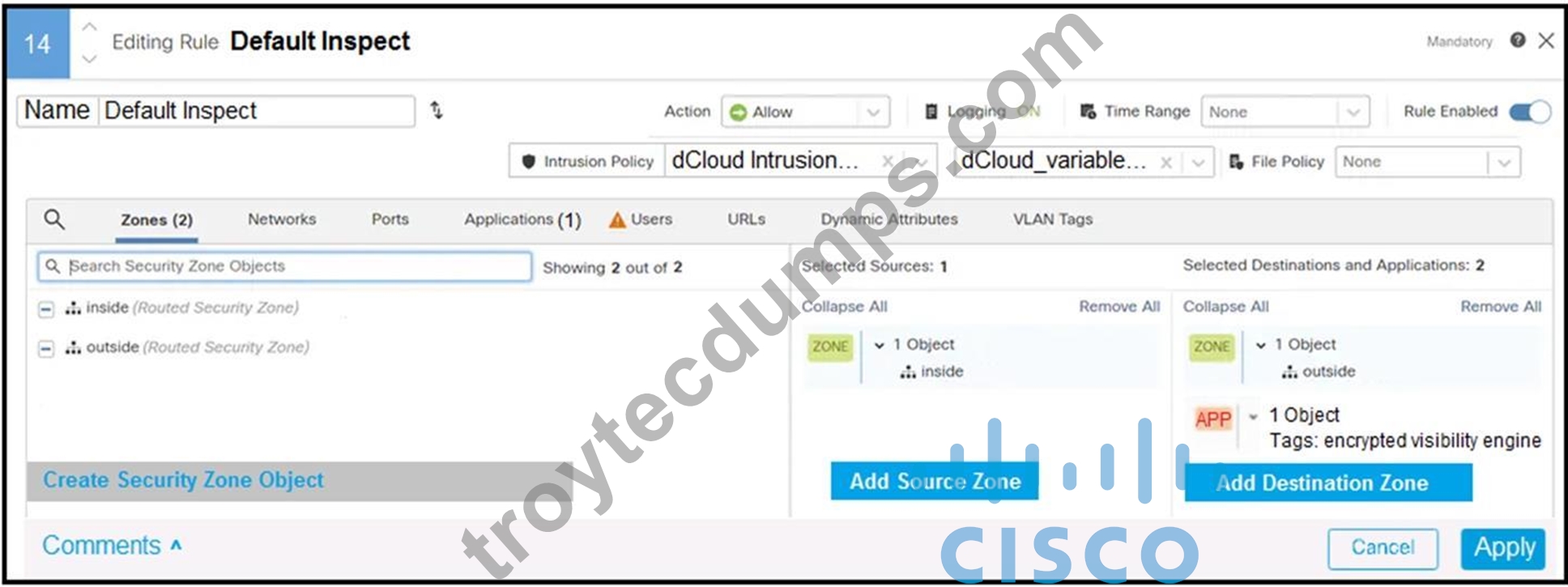
- A. File Inspection
- B. DLP
- C. SSL Offloading
- D. URL Filtering
Answer: A
Explanation:
In the exhibit, SSL decryption is already enabled, which allows encrypted traffic to be inspected.
To block malware hidden within decrypted traffic, the next required feature is File Inspection. This function analyzes files passing through the firewall to detect and stop malicious content.
NEW QUESTION # 60
......
New 300-745 exam dumps Use Updated Cisco Exam: https://pass4sure.troytecdumps.com/300-745-troytec-exam-dumps.html